
Local information for British nationalsEmergency in Norway? 112 · 113 · 110

People, places & shared history

British connections, local stories.

Explore Viking traditions, Scottish merchants, British anglers, mountain pioneers, literary guests and wartime cooperation across the North Sea.

Viking and Norman connections

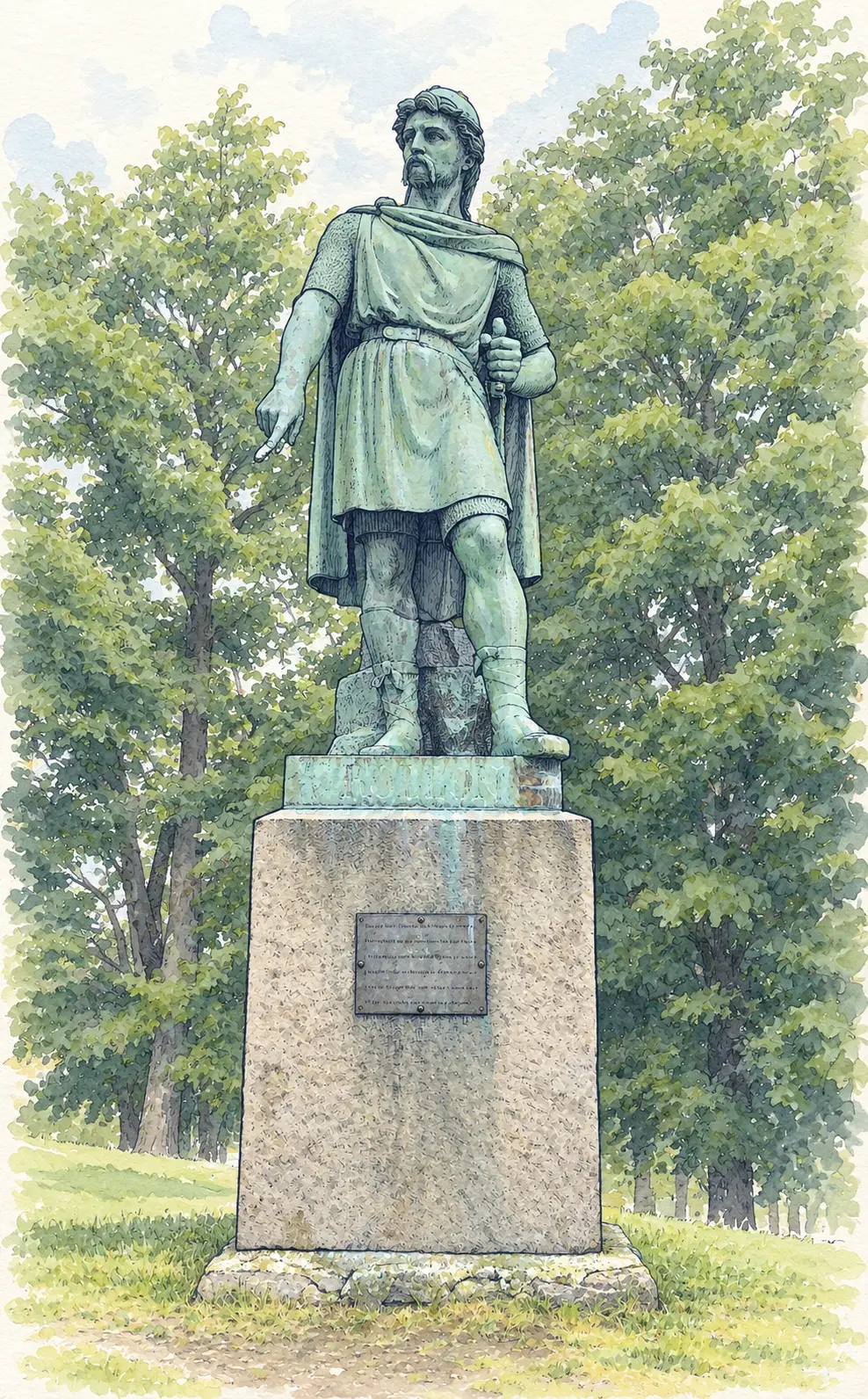
Pen-and-watercolour drawing of the Gange-Rolv statue on its stone plinth in Byparken, Ålesund
Gange-Rolv, Byparken · AI drawing after Olaf Meister · CC BY-SA 4.0
Image info

“Rollo-Denkmal in Ålesund”, photographed 23 July 2019. Source: Wikimedia Commons. AI-assisted pen-and-watercolour adaptation. Fine detail is simplified and incidental visitors have been removed. This adaptation is also available under CC BY-SA 4.0.

Viking age · Møre, Normandy and England

Gange-Rolv, Rollo and William the Conqueror

Norse historical tradition identifies Gange-Rolv, son of Ragnvald, Earl of Møre, with Rollo, founder of the Norman ruling dynasty. Rollo’s descendant William the Conqueror became king of England in 1066. Ålesund’s statue of Gange-Rolv, unveiled in 1911, reflects this local historical tradition.
Explore Ålesund’s museums and heritage

Scottish merchants and seafood

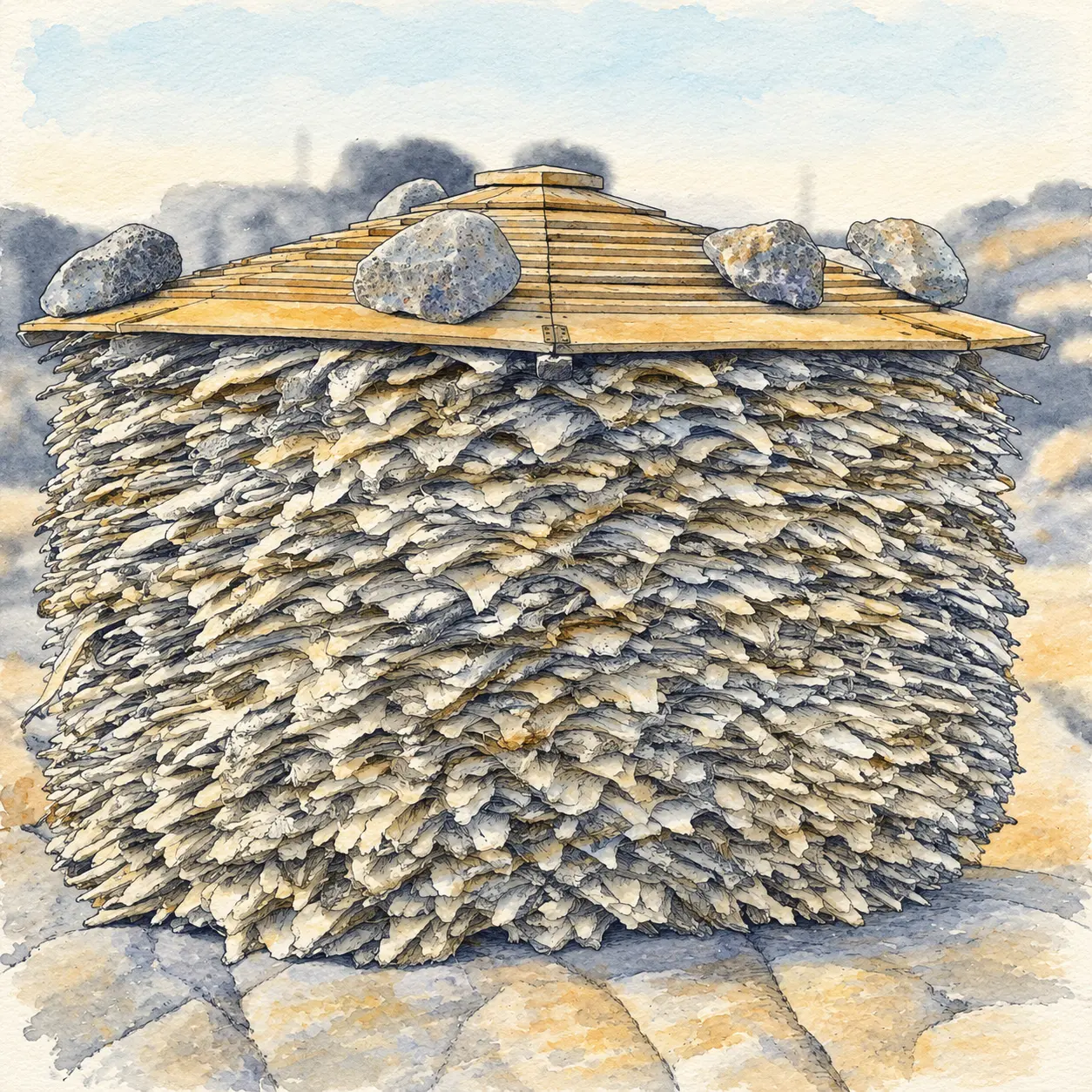
Pen-and-watercolour drawing after a historic photograph of stacked clipfish under a timber cover weighted with stones
Historical clipfish stack, Kristiansund · AI drawing after Anders Beer Wilse / Norsk Teknisk Museum · CC BY 4.0
Image info

“Klipfiskstabel / Dried and salted cod”. AI-assisted pen-and-watercolour adaptation of a historical hand-coloured slide, collection of Sparebankstiftelsen DnB NOR, Norsk Teknisk Museum, identifier DEX_W_00468. The original capture date is not given here. Fine detail is simplified. This adaptation is also available under CC BY 4.0. Source: Wikimedia Commons.

1730s onwards

Kristiansund · Nordmøre

Scottish merchants and the clipfish trade

Scottish merchant John Ramsay settled in Kristiansund in the 1730s and helped develop the production and export of clipfish, salted and dried cod. His early partners included fellow Scots William Gordon and George Leslie. Scottish workers also helped pass production skills to local people. Their story connects the region’s seafood economy with Britain long before modern shipping and cold storage.

Anglers, climbers and literary guests

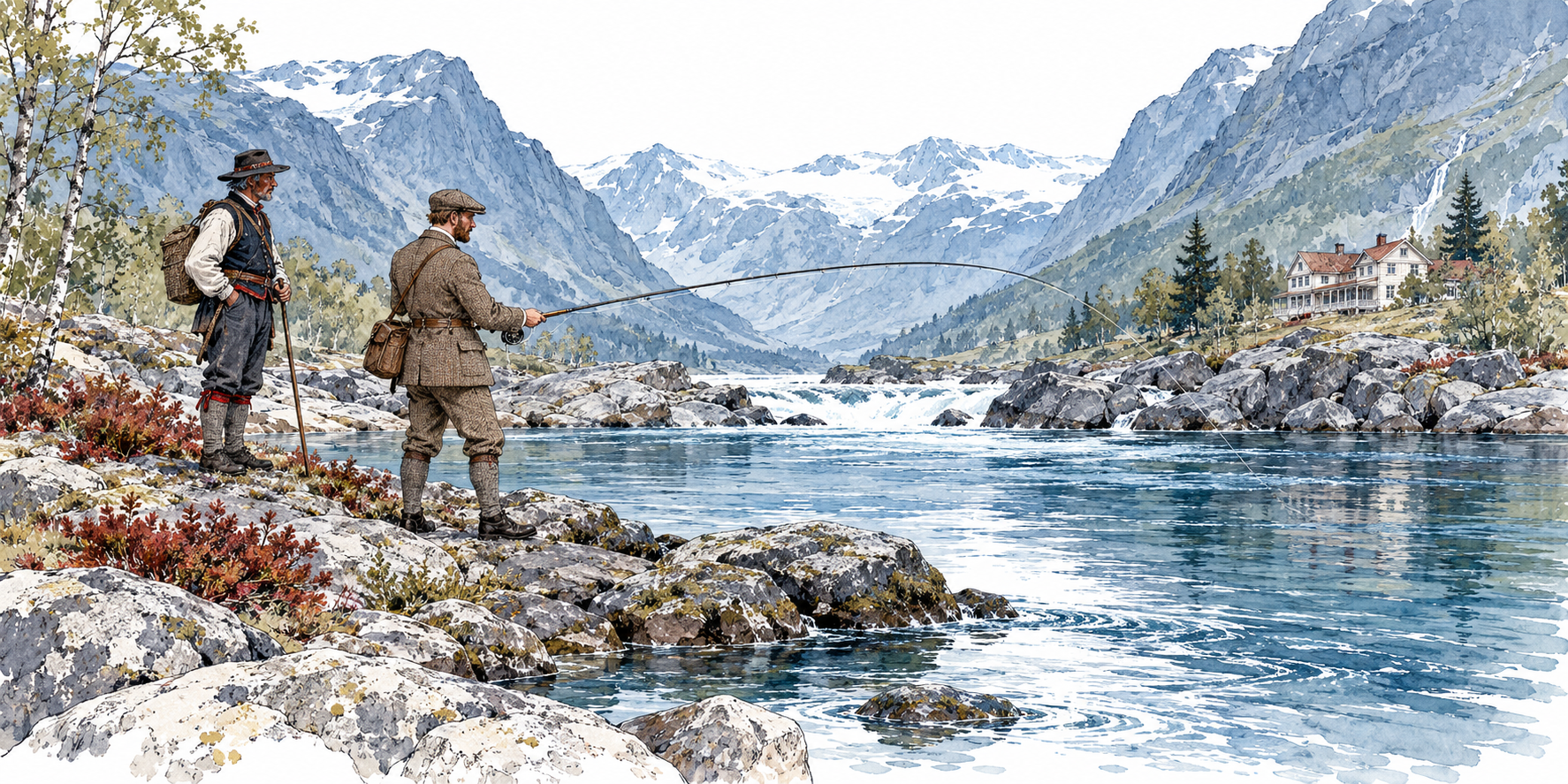
Illustration of a Victorian salmon angler and a guide beside a Norwegian river
British salmon fishing in Norway · AI illustration
Image info

British salmon fishing in Norway · AI-generated historical illustration, not a record of specific people or an event. Created for this guide using AI; an illustrative interpretation, not documentary photography.

1849

Romsdal

Early British salmon anglers on the Rauma

British visitors were among the early travelling sport anglers on the Rauma. A local river history records Lord Beresford and William Bromley-Davenport visiting in July 1849, with Bromley-Davenport describing the fishing in a letter to his father. Reports of English anglers around 1832 also exist, but the same account notes the uncertainty. We therefore do not identify a single visitor as the first British salmon angler in the region.

1860s

Sunndal

Sunndal’s “English era”

From the 1860s, British visitors came to Sunndal to fish for salmon in the Driva. Locally, this period became known as Engelsktida. The legacy includes sporting lodges and the British-style landscape garden at Leikvin.

1866

Sunndal

Barbara Arbuthnott arrives in Sunndal

Barbara Arbuthnott first visited Sunndal in the summer of 1866. She later settled there and remained until her death in 1904. Her life became the subject of the local musical Lady Arbuthnott: Frua på Elverhøy, first staged in 1996.

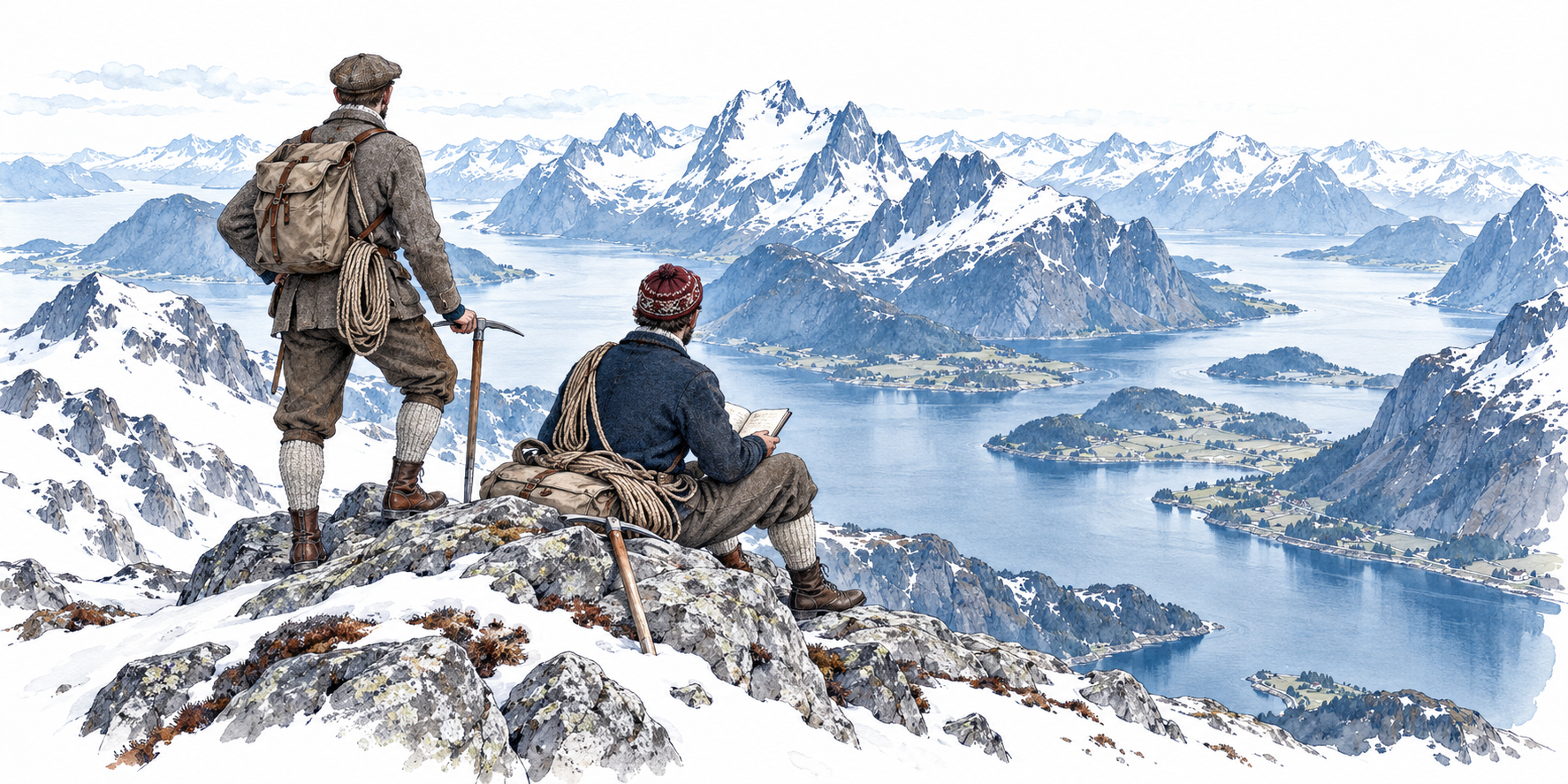
Illustration of two early mountaineers overlooking Norwegian mountains and fjords
Mountain pioneers and their accounts · AI illustration
Image info

Mountain pioneers and their accounts · AI-generated historical illustration, not a portrait or exact location. Created for this guide using AI; an illustrative interpretation, not documentary photography.

1872 onwards

Sunnmøre and Romsdal

British mountain pioneers and their books

William Cecil Slingsby climbed extensively in Norway, including Sunnmøre and Romsdal, often in company with Norwegian guides and climbers. His 1904 book, Norway, the Northern Playground, includes chapters on Sunnmøre, Slogen and the mountains of Romsdal. E. C. Oppenheim’s New Climbs in Norway (1898) focuses specifically on ascents in Sunnmøre. These books let readers encounter the landscape through the visitors’ own accounts.

1927

Sunnmøre

Charles Watson Patchell and the mountains

The English mountaineer Charles Watson Patchell is remembered in the name Patchellhytta. In 1927, he and the local trekking association had the original stone hut built in Habostaddalen, making access to Slogen easier. DNT’s account connects today’s hut with this earlier chapter of mountain travel.

1891 onwards

Øye · Hjørundfjord

British guests at Hotel Union Øye

Opened in 1891, Hotel Union Øye became a meeting place for visitors drawn to the fjords and mountains. The hotel’s own history names British climbers Charles Watson Patchell and William Cecil Slingsby, as well as Arthur Conan Doyle, the creator of Sherlock Holmes. This adds a literary connection to the better-known story of British mountaineering in Sunnmøre.

War and resistance

1940

Romsdal

British troops land at Åndalsnes

Following Germany’s invasion of Norway in April 1940, British troops landed at Åndalsnes during the Allied campaign. The Green Howards Museum describes its regiment’s movement south towards Kvam and cooperation with Norwegian forces. The National Army Museum places these events in the wider campaign.

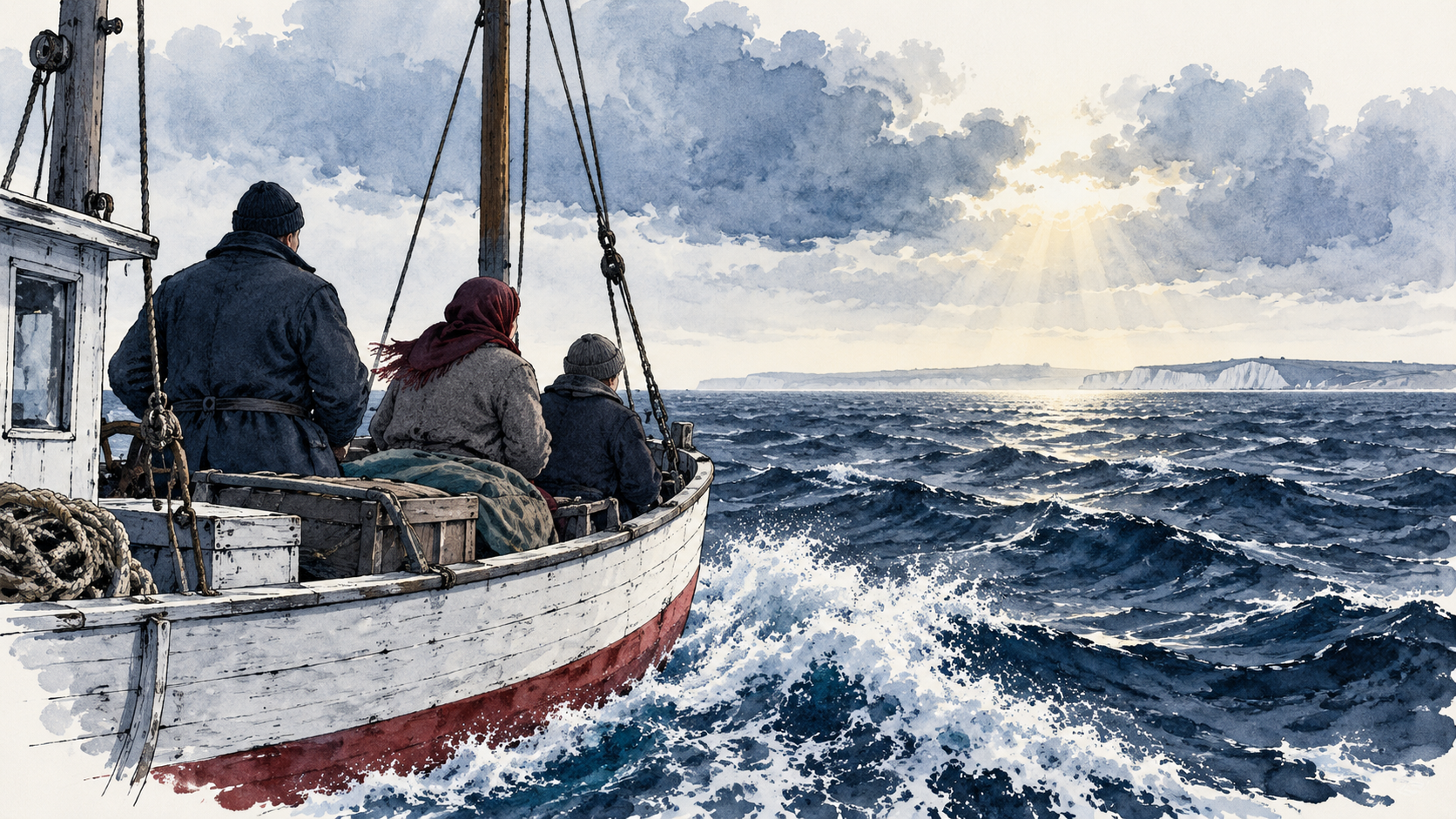
Illustration of civilians aboard a fishing boat crossing the sea towards Britain
Englandsfarten · AI illustration
Image info

Englandsfarten · AI-generated thematic illustration of wartime crossings, not a specific vessel, route or event. Created for this guide using AI; an illustrative interpretation, not documentary photography.

1940–1945

Ålesund and the Møre coast

Englandsfarten: the sea route to Britain

During the occupation, groups in the Ålesund area helped organise crossings from Norway to Britain. Fishing boats carried people across the North Sea, often to Shetland, including those escaping persecution or seeking to join the Allied war effort. The crossings and the networks behind them form an important part of the region’s relationship with Britain, alongside the military campaign of 1940.

1940–1941

Linge, Norddal · Sunnmøre

Martin Linge: from Sunnmøre to British special operations

Martin Linge grew up at Linge in Norddal on Sunnmøre. An actor and army officer, he served as a liaison officer with British forces during the fighting around Åndalsnes in April 1940. After being wounded, he was evacuated to Britain. There he helped build the Norwegian special-operations unit later known as Kompani Linge. He was killed during the British–Norwegian raid on Måløy, Operation Archery, on 27 December 1941.

1941–1945

Norway and the United Kingdom

Kompani Linge and the Scottish connection

Norwegian Independent Company No. 1, better known as Kompani Linge, brought together Norwegian volunteers trained in Britain for operations in occupied Norway. Initially part of the British Special Operations Executive (SOE), it later came under Norwegian military command while retaining its SOE connection. Training in Scotland prepared its members for sabotage and cooperation with the resistance at home. Its story is a particularly close link between Britain and the wartime experiences of people from Møre og Romsdal.

1943

Borgund and Ålesund · Vemork in Telemark

Joachim Rønneberg and Operation Gunnerside

Joachim Rønneberg was born in Borgund, now part of Ålesund, in 1919. He escaped to Shetland in 1941 and joined the Norwegian forces training in Britain. On the night of 27–28 February 1943, he led the Gunnerside team in the successful sabotage of the heavy-water plant at Vemork. The operation took place in Telemark, but its leader’s roots were here in Sunnmøre. A statue outside Ålesund Town Hall commemorates him.

1944–1945

Tafjordfjella and the Rauma railway

Operation Fieldfare: resistance in the local mountains

Rønneberg later returned to Norway with fellow Linge soldiers Birger Strømsheim and Olav Aarsæther for Operation Fieldfare. They parachuted into Tafjordfjella in March 1944 and waited in the mountains for orders from London to attack the Rauma railway. In January 1945, they sabotaged Stuguflåten bridge. The restored Fieldfare hut preserves the memory of this local operation.

War & memory

Ulstein and the islands around Ålesund

Ragnar Ulstein: a participant who preserved the stories

Ragnar Ulstein, born in Ulstein in 1920, crossed to Shetland in 1941 and served in Kompani Linge. After the war, he became a journalist and a major chronicler of resistance, escape routes and intelligence work. His books include Englandsfarten: Alarm i Ålesund and Småsamfunn i storkrig, about Giske during the occupation. His interviews helped preserve the experiences of people whose contribution might otherwise have been overlooked.

A Farstad connection in wartime England

Sverre Andreas Farstad Sr., great-grandfather of the present honorary consul, helped Norwegian seamen in England and became the driving force behind the Norwegian Home Guard unit in Sunningdale. His wartime interview adds a personal Ålesund connection to this history.

Maritime heritage today

The clipfish trade, seafaring skills and crossings to Britain connect with today’s maritime economy. Blue Maritime Cluster links businesses, education and research across the region.

Visit and read more

Explore the history locally

Leikvin in Sunndal introduces the history of British salmon fishing and Barbara Arbuthnott. The Norwegian Clipfish Museum in Kristiansund explores the trade that attracted Scottish merchants. Aalesunds Museum presents local wartime history. Check each venue for opening times and access.

A selection of documented British connections. Sources accompany each story.